
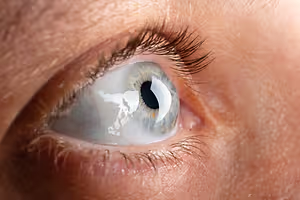
A glasses prescription should bring the world back into focus. If blurry or distorted vision keeps returning, astigmatism keeps changing, or a new prescription offers limited improvement, the shape of the cornea may deserve a closer look.
Keratoconus changes the structure of the cornea, the clear front surface of the eye. As the cornea becomes thinner and develops a steeper, cone-like shape, light enters the eye unevenly, and vision can become distorted. At The Vision Hub, our eye doctors provide specialty contact lens care for patients whose vision needs go beyond standard glasses and contacts.
Early Keratoconus Symptoms
A healthy cornea has a smooth, rounded shape that helps focus light. Keratoconus thins and bulges the cornea outward. This changing shape can create irregular astigmatism, meaning the cornea curves unevenly and struggles to focus light into a sharp image.
Keratoconus often begins during the late teens or early 20s and can change gradually over many years. Each eye can progress differently, which means vision may feel sharper in one eye than the other.
Blurry or Distorted Vision
Keratoconus can make straight lines appear bent or wavy. Fine details may lose their crisp edges, and ordinary tasks such as reading road signs or working on a computer can become harder.
This distortion differs from simple blur because an irregular cornea scatters incoming light. Standard glasses may help in earlier stages, but greater corneal irregularity may require a different approach to vision correction.
Glare and Light Sensitivity
Bright lights may become harder to tolerate as keratoconus changes the way light passes through the cornea. Some people notice more glare, light sensitivity, or difficulty seeing clearly at night.
These symptoms can become especially noticeable around headlights and other bright points of light. A comprehensive assessment can help our eye doctor determine whether the cornea plays a role in those visual changes.
Increasing or Irregular Astigmatism
Astigmatism describes a difference in curvature that prevents light from focusing evenly. Keratoconus can create a more complex form called irregular astigmatism as the cornea changes shape.
That distinction matters. Standard glasses and soft contact lenses can correct many common prescriptions, but an increasingly irregular corneal surface may limit their clarity.
Contact Lenses That Fit Differently
Corneal shape affects how a contact lens sits on the eye. As keratoconus progresses, conventional contacts may begin to move, fit poorly, or provide less consistent vision.
Changes in contact lens comfort or performance deserve an assessment rather than another round of trial and error. Contact lenses are medical devices, and The Vision Hub uses dedicated contact lens evaluations to select lenses for visual clarity, eye health, and comfort.
Modern Keratoconus Treatment Paths
Keratoconus treatment depends on the cornea, the degree of visual change, and whether the condition is progressing. Early cases may respond well to glasses or soft contact lenses. As the cornea becomes more irregular, rigid or custom contact lens designs can provide a smoother optical surface and clearer vision.
Treatment also has two different goals that patients should understand. One is improving the vision affected by an irregular cornea. The other is addressing progression of keratoconus itself. Custom contact lenses can provide visual correction, while an appropriate provider may consider medical or surgical procedures such as corneal cross-linking if the corneal condition continues to progress.
Why Irregular Corneas Require Custom Scleral Lenses
Scleral lenses take a different approach from conventional contact lenses. Rather than resting directly on the cornea, these larger lenses rest on the white part of the eye, called the sclera, and vault over the corneal surface.
The space between the lens and cornea holds preservative-free saline. This fluid reservoir helps create a smooth optical surface over an irregular cornea. For some people with keratoconus, the result can be clearer and more stable vision than glasses or conventional soft contacts can provide.
A Lens Designed Around Your Cornea
Irregular corneas vary from person to person. A custom fitting lets our eye doctor assess how a lens sits on the eye and adjust it based on shape, clearance, movement, vision, and comfort.
The Vision Hub offers scleral and custom contact lens designs for patients who need options beyond standard contacts. Contact lens evaluations focus on finding a lens that fits the patient's vision and comfort needs.
Stability for Irregular Astigmatism
A standard soft lens generally follows the shape of the cornea beneath it. When that surface is substantially irregular, the lens may provide limited correction for the distortion.
A scleral lens vaults over that irregular surface instead. The fluid-filled space beneath the lens helps create a more regular optical surface, giving incoming light a clearer path through the eye.
That difference explains why someone can have limited clarity in glasses yet see more sharply through a carefully fitted scleral lens.
Comfort Through a Fluid Reservoir
The size of a scleral lens can sound intimidating to someone accustomed to small soft contacts. Its design, however, lets the lens rest on the sclera rather than bear directly on the sensitive corneal surface.
The saline reservoir also keeps fluid over the cornea while you wear the lens. Comfort varies from patient to patient, so careful fitting, follow-up care, and proper lens handling remain key to successful wear.
Clearer Vision Starts With the Right Corneal Care
Changing prescriptions, growing astigmatism, distorted vision, and difficulty getting clear results from standard correction can all point toward a cornea that deserves closer attention. Identifying the cause of those changes creates a clearer path to the right form of vision correction.
If you've searched for a keratoconus specialist near me or scleral lenses near me, start with a clinical assessment from our eye doctors at The Vision Hub. Our team serves patients across Northwest Florida with personalized eye care and custom contact lens options. Request an eye care appointment to talk about your changing vision and whether a scleral lens fitting may suit your eyes.